
MSUAS Hosts Public Lecture on Innovative Technologies for Agribusiness
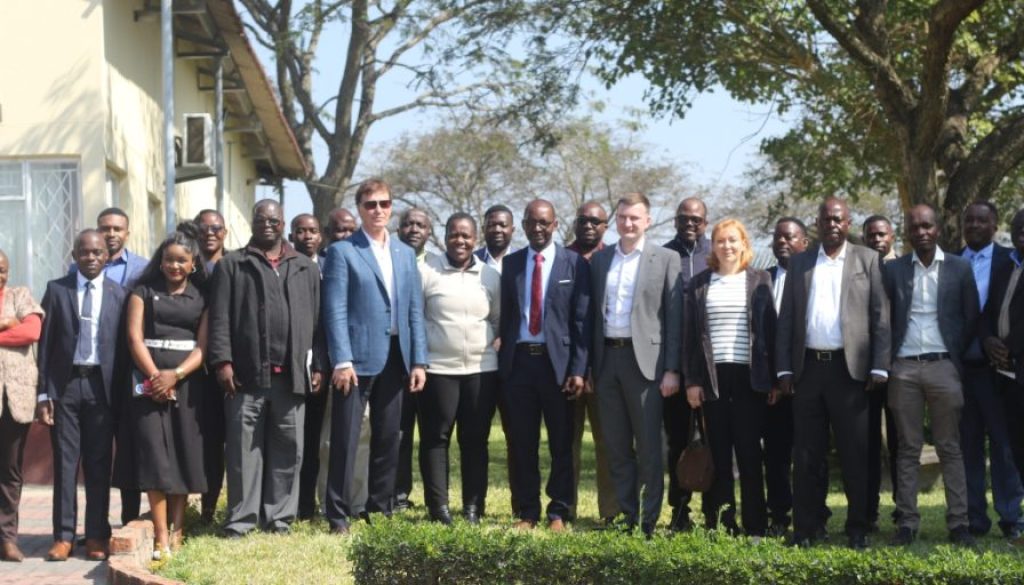
In a move to advance cutting-edge engineering and technological innovation in modern agribusiness, Manicaland State University of Applied Sciences (MSUAS) hosted a high-level public lecture at Fernhill Campus, Mutare.
Running under the theme, “Innovative Technologies for Agribusiness: Agrotechnological Complex Development for Differential Harvesting and Raw Material Processing into Feed,” the lecture was delivered Professor Dmitry Rudoy from Don State Technical University (DSTU) in Rostov-on-Don, Russia.
In his remarks MSUAS Vice-Chancellor, Professor Albert Chawanda, represented by the, Pro Vice-Chancellor, Professor Upenyu Guyo reaffirmed the institution’s commitment to serving as an active catalyst for Zimbabwe’s socio-economic development through research, innovation, and international academic collaboration.
“Universities are not merely centres of teaching and learning; they are engines of knowledge generation, innovation, technological advancement, and societal transformation. At Manicaland State University of Applied Sciences, our guiding philosophy is captured in our motto: Research, Innovation, Sustainable Development,” said Prof Chawanda.
“As Zimbabwe pursues Vision 2030 and the aspirations of the National Development Strategy 2 (NDS2), innovation within the agricultural sector will play an increasingly vital role in transforming our economy into one that is modern, industrialised, and globally competitive. The future of agriculture depends on our ability to embrace science, engineering, and technology that improve productivity, enhance efficiency, minimise waste, and increase value addition.”
He expressed gratitude to DSTU and the Centre for Education Innovation Research and Development (CEIRD) for facilitating the international partnership, highlighting that global academic cooperation is essential for addressing complex challenges like food security and sustainable industrialisation.
During the presentation, Professor Rudoy showcased developments from DSTU’s flagship DonTech program including the Southern Scientific and Educational Centre.
He presented DSTU’s integrated approach to solving a key bottlenecks in agricultural production — linking differentiated crop harvesting directly with raw-material processing into livestock feed as a unified engineered system rather than separate operations.
“Traditional agricultural workflows treat field harvesting and stockfeed processing as completely isolated steps. By integrating differentiated crop harvesting directly into the raw-material feed processing chain, we transform what was once a major production bottleneck into a continuous, unified engineered system,” said Prof Rudoy.
The lecture prompted active engagement from MSUAS researchers and students who engaged Prof. Rudoy on practical strategies for adapting differential harvesting as well as automated feed-processing technologies to local Zimbabwean farming conditions and smallholder frameworks.
Attendees and university leaders hailed the lecture as an eye-opening experience, bridging the gap between classroom knowledge and practical industrialisation.
By bridging international academic expertise with regional agricultural needs, MSUAS continues to strengthen its role as an applied sciences institution focused on practical solutions, industrialisation, and long-term food sovereignty.